Monday, December 28, 2015

Humanity of Jesus: Sermon on Luke 2:41-52

Last sermon of 2015 for the community of Zion Lutheran in Amor

Gospel: Luke 2:41-52
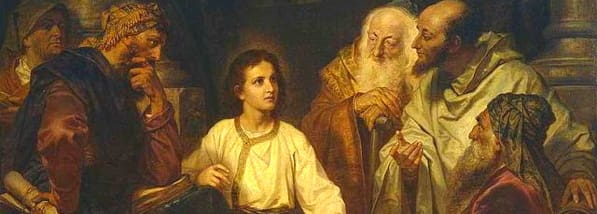

There was a print of this painting hanging in the basement of First Lutheran in Morris
I never understood the significance of it until now....


Merry Christmas!

I usually don’t start out with a story about myself, and ultimately, it’s not a story about me. It’s a story, actually, about my son, Sam. You’ll figure out why I’m telling this story in a minute. We were living in St. Paul the last few years, and two Februarys ago, Sam was almost two. We were visiting a large Methodist church watching a friend preach, and before the service, we were given a tour of this large, magnificent church. So, during the service, the three of us sat off to the side while Sam calmly played with the toys next to us. The service was nice, my friend preached a beautiful sermon, and after the service, we got a chance to congratulate him on his sermon. We had just finished talking, and noticed Sam was no longer with us after the conversation. Sam was gone.

In a large, urban Methodist church, in which we’d never been before, Sam was gone. I don’t know how many of you have misplaced children for an extended period of time before, but Tiffany and I were scared. Frightened. We knew Sam was adventurous, but after spending what seemed like an eternity checking all the offices, the sanctuary and the upstairs area, we knew Sam wouldn’t venture stairs by himself. At less than two years old. A 23-month old child wouldn’t venture down the stairs, would he? Panicked at what a young toddler could do going down strange stairs could mean… We hurried down the stairs. Down the long winding hallways of this large Methodist church, there he was. In the nursery, calmly playing with toys like nothing was wrong. There was our Sam, playing with toys he’d remembered about from the tour before. There was our Sam, doing what came naturally to him: being adventurous and playful.

So also was Jesus doing only what came naturally to him. Jesus was out and about in the world, learning from the teachers and asking questions. Where else would he be but with the people? Jesus spends the majority of his ministry out and amongst the people. Jesus wasn’t a monk locked away studying, but learning and teaching amongst the people. Jesus was the long-awaited newborn King, but he didn’t rule from a lofty throne high upon a tall tower. Jesus lived, learned, and taught with people just like him. For Jesus was entirely human. Unequivocally, 100% Human. What better way to show the humanity of Jesus than to show Jesus as a small child, disobeying his parents by staying behind.

This is the only mention of this story in all of the Gospels. Only the author of Luke wrote about Jesus’ childhood. In Mark and John, we start right away with Adult Jesus. Matthew and Luke are the only Gospels that mention the story of the Nativity. And Luke is the only Gospel that mentions Jesus as a child.

Jesus’ humanity is shown here with Jesus as a child disobeying his parents, and being a typical inquisitive child. In Mark, Jesus calls a little girl a racial slur. In John, he takes out a whip and starts tossing a whip around in anger. Heck, he even cries when his friend Lazarus dies. The Humanity of Jesus is something that is difficult to understand; difficult to grasp; difficult to figure out. Jesus is God. Jesus is Human. Jesus is both. Jesus was born of a woman, but yet is the Son of God. He’s perfectly imperfect.

Why, do you think, is it difficult for us to rationalize Jesus as a fallible human being? Why is it difficult to rationalize any important person as a fallible human being? Celebrities, as high and lofty as they seem to be, up and away from everyone, are still human. They have affairs, divorces, diseases, and even bathroom breaks. They struggle with mental health issues, addiction, and injuries. They break the law, get away with it, and get on with their lives. They fight for the same causes we do, and fight against the same causes we fight against. They stand for values that we value, or values we don’t. The veil is lifted, and suddenly, they’re more human than they originally seemed.
That goes for all of us as well. We’re all human beings. We’re all fallible. We all screw up occasionally. We all have little quirks who make us who we are. We have mental health issues, physical ailments, the general wear and tear of the body. I have to say... I’ve learned more about the human eye from talking with folks here with glaucoma and macular degeneration, than I have ever. Uffda. It’s one of those body parts we definitely take for granted. Sight is one of those senses that we take for granted until we start to lose it.

Time… Time is one of those things that we take for granted. I’m younger than some of your grandchildren, and yet the passage of time has always fascinated me. You wait and wait and wait for a day to arrive, and suddenly, before you know it, it’s here. Screaming in your face at 3 in the morning. Then it’s walking, and talking, and running, and jabbering, and endless conversations and questions. Oh the questions.

We take humanity for granted. When the realities of humanity stare us in the face, and we’re awestruck by them. It’s still Christmas, and we want the baby boy child to stay in the manger. We want that effervescent glow of Christmas to continue. For the star to still hang over us. For the shepherds to keep watch. For the angels to sing out their angelic choruses. We keep the Christmas tree up forever it seems. When I was growing up, we sometimes kept the tree up until Good Friday, or even Easter. We don’t want to let go of that feeling.

We don’t want the harsh realities of humanity to creep in. We don’t want to read on in the Gospel of Matthew that Herod slaughtered children looking for Jesus. It’s hard for us to move on from the manger in the stable. It’s hard for us to realize that the Savior born that night in Bethlehem; the long awaited Savior of the World, in the form of a child… would one day disobey his parents and lose himself amongst those in the temple. This little child wrapped in swaddling clothes and laid in a manger… would one day have a dinner with his friends. A dinner, where even his friends didn’t want to rationalize that this Messiah friend they knew, was about to go to his demise. This Emmanuel, God Incarnate, would have to face a fate destined only for the worst of criminals, the lowest of the low… That one night, the long-awaited Messiah would hang on a cross, and die… to save us all… from ourselves. That one bright and cheery morning soon thereafter, the baby boy child who was once wrapped in swaddling cloths, would shed his burial robes and rise again, to save us all. That the undeniable Grace, Love, and Mercy that comes from God, shone like the Sun that morning, breaking through the bonds of our sin to bring salvation to all.

That even despite our humanity; that even despite our brokenness; our fear and anxieties… Jesus the Christ died for us and saves us all. This Truth, this Good News - is hard for us to grapple with. That the realities of sin and death are nothing for the power of God’s Love. That the realities of humanity, and the brokenness of this world… Are right up God’s alley. For God was made human through the life of Jesus Christ. The Emmanuel. God understands the brokenness, and is right there with us in the thick of it. God is with us in the manger, in the temple, at the Last Supper, at the Cross, and after the grave. God’s humanity springs forth and shows up in the darkest of places. Even when temporarily misplacing a child, when all the fears rush forth in your head of all the darkest of scenarios… God is with us. God is with you.

So the end of the year is fast approaching. Another year, another leap year for that matter... is fast upon us. Christmas is still with us for a  few more days, and you have my permission to leave the tree up for as long as you want. As we look back on the year here at Zion, in our community, in our state, nation and world… think of ways God was present with you and your life. Think of the times in which God felt distant, like God was missing somewhere else for an extended period of time… You know where God was, is, and will be. Right where God should be. God is with you. No matter what.

Amen.

Monday, December 14, 2015

What Then Should we Do?: Sermon on Luke 3:7-18

This is my sermon for Lucia Sunday at Zion Lutheran of Amor


Gospel: Luke 3:7-18

Grace and Peace to you from God our Creator, and from Jesus the coming Messiah, Amen

“What then should we do?” Take what you have too much of, and give it to those who don’t. Take the abundance, and provide to the scarcity. For the Son of God is coming to level the playing field. The Messiah, the Savior of the World; is coming to turn the world on it’s head. The mighty shall be made low. The wheat will be separated from the chaff; the fruitless tree will be cut down. Jesus the Christ is coming, and he will save us all from ourselves.

From our selfishness, our bigotry, our pain, our sorrow, our broken selves. John the Baptizer stands there in the wilderness; the Good News of Jesus Christ having bypassed all the rulers of the land, even the high priests in the temples. The Good News came to a wild man out in the Wilderness. On the banks of the river Jordan, the Good News came to John the Baptizer. A man of the common folk. John the Baptizer, stands there in the wilderness, and proclaims the Good News. One who is related to the Messiah, but is not the Messiah. John the Baptizer calls out to the people to give of their plenty to those who have none. All are equal in Christ Jesus,  but for those living on the bottom of the equation, life's not so equal.

Of the 58,000 or so residents residing Otter Tail County, around 12% of the county’s residents live at or below the poverty line. While this county has a higher poverty rate than the state average of 11%, we have a low unemployment rate of only 3%. Minnesota’s unemployment rate and poverty rates, are both in the lowest 10 of the country. Our neighbor, North Dakota has the lowest unemployment rate at 2.8%.

So, we have jobs. We have people working those jobs, and yet we have a higher than state average poverty rate. There’s a disconnect there, and I’m not entirely sure what the disconnect means. Sure, we have seasonal employment, but I don’t think that’s the nature of the discrepancy. This conversation has been going on in my head for some time now, but the idea is the same - poverty is a reality that needs to be addressed, and everyone knows it. We’re taught, whether implicitly or explicitly, on purpose or on accident - from a young age that there are entire groups of people that we ignore or discriminate against.

Whether by race, creed, religion, wealth, gender identity or sexual orientation - we’re  taught from a young age that there are people different from us, and they are to be feared. Each generation has their token group, but otherness has scared us from the beginning of humanity. It is this otherness that keeps us at bay. Away from the knowledge of the other. So we keep them at arm’s length. Whether symbolically or proclaiming to the entire nation that an entire group of people is not welcome in our country… Otherness scares us.

While this theme of otherness being feared has been a constant since the dawn of humanity - the overarching theme of God telling us to get over ourselves has also been there. From the story of Cain and Abel - to Pharaoh fearing the Israelites to Moses sending the scouts into the Promised Land, only for the scouts to feel like grasshoppers to the people already residing there - to the story of Christmas and Herod fearing children… Otherness has been feared and God tells us to get over it. To embrace difference. To love one’s neighbor, just as God loves us. According to Jesus, that is the greatest commandment.

And yet, we persist. We keep the world’s harsh realities at bay, because we don’t want to disturb the life we have. We don’t want to know. We bury our heads in the sand and we hide. Maybe we’ll throw a dollar or two at it and hope that it goes away. Maybe we’ll close our church doors, and only allow certain people to come worship; to come to the table; to sit with us. We fear the unknown. The poet, Ralph Waldo Emerson postulated that “What we fear of doing most is usually what we most need to do.”

I’ve told this story a couple times in different places, but in January I sat across the table from Senator John Marty, the son of a prominent Lutheran scholar and brother of a Lutheran pastor in Iowa. He is a champion of fighting for impoverished Minnesotans, and on that day in January, told me the story of the 2006 legislative session. The Minnesota Legislature passed a Legislative Action to End Poverty by 2020 that year. That wasn’t the big ticket item in the legislature that year. At the same time, the legislature was engaged in talks about building Target Field, where the Minnesota Twins play. In one of the discussions, Senator John Marty stood up and plainly asked why we had to wait until 2020 to end poverty, when we could just ask the owners of the Minnesota Twins to end it for us right then and now… Crickets. The discussion continued without even getting that a thought.

The answers are staring us in the face. God calls us to love one another, and yet, we’d rather talk about why the other isn’t deserving of love. God calls us to clothe and feed the impoverished. We’d rather talk about how hard it would be to do anything about poverty. God calls us to welcome our neighbor. We’d rather talk about why they want to harm us.

This country was founded on welcoming the neighbor. My ancestors, our ancestors, were all welcomed here at one point. We have different ancestors from different parts of the world, and yet, here we are.

Here we are celebrating an Italian Catholic saint from 4th century Sicily because it’s a Swedish Lutheran tradition and most of the congregation is more Norwegian than anything… Talk about multiculturalism. Think about that: Here we are, in the middle of the United States of America, celebrating the life and service of a young girl from 4th century Sicily, more than 1700 years after she died. Saint Lucy, or Santa Lucia, or Loosha as we refer to her; lived in Syracuse in the late 3rd century. According to legend, she refused to marry a pagan, as she was Christian and didn’t want a life of indentured servitude to her pagan husband, and gave all of her dowry to the poor. A girl of noble birth, of wealth and status; gave most of what she had to serve the poor. She was martyred in 304 CE. Then, as the years went on, her story struck a chord with the hungry Swedes in Varmland Sweden, and since the 16th century, Lutheran Swedes have celebrated the arrival of a young girl providing food for the hungry. This day, the 13th, was once considered the darkest night of the year, and the image of a young girl with light around her head bringing food to the hungry - bringing light to their darkness - became a beautiful symbol that Swedish Lutherans held onto.

So John the Baptizer stood there on the banks of the Jordan, proclaiming the good news that the Messiah was coming, and he was coming to level the playing field. The Messiah was the light in the darkness. John told the crowds of people to give from their plenty to feed the less fortunate. Lucia took from her dowry and fed the hungry. Bringing light into the darkness.

Jesus is the Light that shines through the darkness. Through the fire and the flames we carry on. Jesus, this Light of the World, that shines for all of us - was born in the lowest of low places, and died on the highest tree around. Jesus, the Savior of the World, died and rose again, to save us all, from ourselves. From our bigotry, our selfishness, our hatred, our ignorance, our darkness, our shame. Jesus the Christ saves us all, by the Grace of God. This unimaginable Grace, Love and Mercy that does not, will not, and cannot end.

That is the Good News that John was shouting in the wilderness. That is the Good News that we each proclaim each day. There is so much darkness in the world, but Jesus shines through it. God’s Light shines through the darkness of this world, and shows us the way. Jesus is the Way, the Truth, and the Life. We respond to this Grace, Love, and Mercy by doing exactly as God calls us to do - to welcome our neighbor with open arms. To love our neighbor as God loves us. To clothe and feed the impoverished, as God has clothed and fed us. God calls us for a life of service to our fellow human being. It’s in the music of the season. In a few weeks, we give of ourselves to our family, our friends, and our neighbors. We continue a tradition of providing joy in the form of Christmas gifts. We continue a tradition of providing light where there is darkness. Abundance where there is scarcity.

What then should we do? Love our neighbor. Feed the hungry. Clothe the naked. Welcome them in with open arms. Proclaim the Good News of the awaited Messiah.

Amen.