Monday, July 31, 2017

Throwing Around

This is my third sermon preached at Living Waters as part of my internship. Preached on 7/30/17, I wanted to preach a 'safe' sermon to balance out the previous one.

Epistle: Romans 8:26-39
Gospel: Matthew 13:31-33, 44-52


Grace and Peace to you, from God our Loving Creator, and our Lord and Savior, Jesus the Christ, Amen

A mustard seed. A clump of yeast. A treasure in a field. A merchant in search of fine pearls. A fishing net. Parables are tools that Jesus uses to ‘throw around’ ideas of God and the kin-dom of God. In Greek, the word parable or paraboli means to ‘throw around’. When playing catch with a ball or a frisbee, the object is to ‘throw around’ the object, so that another person can go ahead and catch it. The idea isn’t to throw it sooo out of the way that they won’t catch it, but to practice your own skills of throwing, and in return, catching. So that the other person has a better chance of likewise, catching. You throw around the ball for mutual enjoyment, learning, and growing.

Jesus ‘throws around’ these parables, even if some of them don’t make complete sense. When Jesus asks the disciples if they understand what he’s talking about, and they all nod in agreement and say, “Yes.”... I’m gonna go ahead and say that they probably didn't. Because maybe that’s not the point. Because there isn’t a single way of understanding these. Or a single audience.

When you ‘throw around’ a ball, there isn’t a singular way of throwing so that the person will catch it. There isn’t a singular way in which the person can catch it. There isn’t a singular person you can successfully throw to, and the rest just don’t catch them…

Because sometimes you miss. Sometimes when ‘throwing around’ a ball, the ball goes too high, or too low, or the wind catches it, or a bird flies in front of it or whatever. When a ball is thrown around… Limitless possibilities abound as to how that ball will travel, and it’s a matter of determining the best odds as to how that ball can be caught.

Jesus tells many parables to help ‘throw around’ ideas that inform people about God, but none of them complete the whole picture. The kin-dom of God is like… The kin-dom of God may be equated to… You could think of God as… Jesus is like…

Nothing we say will ever give a complete picture of God or the kin-dom of God. Words may get in the way as to how we describe God, but nothing can truly separate us from God. The Apostle Paul asks the question in his letter to the Romans, “Who will separate us from the love of Christ? Will hardship, or distress, or persecution, or famine, or nakedness, or peril, or sword?” He then replies to his own question. Nothing. Paul writes, “For I am convinced that neither death, nor life, nor angels, nor rulers, nor things present, nor things to come, nor powers, nor height, nor depth, nor anything else in all creation, will be able to separate us from the love of God in Christ Jesus our Lord.” (Romans 8:35, 38-39 NRSV)

Last week, Jesus talked about the wheat and the weeds, and how we cannot take the weeds from the wheat, because the wheat would come with the weeds. It’s not up to you to decide who or what or how or whatever - the weeds are. Personally, I believe that we are all made up of wheat and weeds, but you would have had to come to my other internship site to hear that sermon.

One way you could look at these parables is if you place your own self, or your own faith... in the center of them. Your faith is the mustard seed, the yeast, the treasure, the fine pearl… But allow me to put it in another light - what if Jesus is the mustard seed, the yeast, the treasure, the fine pearl? Jesus the mustard seed, grew into a large tree where every kind of bird rests in his branches. Jesus the yeast makes the flour leavened. Jesus the treasure for all. Or your own treasures - your time, your talents, your money - If you think of it with stewardship in mind - that all that we have is God’s, and all that was given to us was given to us by God… Then by sharing the gifts of God - Your gifts, like a mustard seed, grow into a large tree, where they have untold futures of bestowing life to many, in the form of a small mustard seed. A little can go a long way. Or your gifts are what makes flour leavened, into beautiful bread for all to consume. One little ingredient that has a big impact.

Did you notice I saved one of the parables? This one doesn’t as easily translate the same way into a multi-leveled parabolic metaphor the way the others do.

This one is my favorite among the selection that we read this morning. The fishing net. Jesus is a fishing net - that catches fish of every kind… then the fisher draws in the net, separating the good fish from the bad fish. Jesus adds commentary, saying that so it will be at the end of the age… the angels will separate the righteous - hold onto that word, “righteous” - from the evil ones. Then the evil ones will be tossed into the fire where there will be lots of weeping and gnashing of teeth.

I’m gonna go ahead and examine that first part - the fisher throws in a fishing net, catching fish of every kind. Every kind. Jesus the fisher, throws his net into the world, catching fish of every kind (that’s humanity). Let’s skip the separating from the good ones and bad ones to the part where Jesus describes who is separated.

The righteous from the evil ones. The righteous - righteousness in Greek, is equated with the word for justice. Therefore the righteous ones are the just - the ones that fight for justice. In this parable - Jesus is pointing out that the justice-minded folks are the ones that are saved from the fire of weeping and gnashing of teeth.

But what is “justice”? What is this word that gets ‘thrown around’ so much these days? Well, I’m glad you asked. (PS, this is a shameless self promotion for a deeper look into justice - in an eight-week-long study coming this fall - where we will dive into topics of social justice… but more on that later)

Justice can be seen as the application and advocacy of egalitarianism and equity for us all. The idea that was set down for us all by the founders of this country - that we are all created equally, and all equally endowed with a set of unalienable rights. Social Justice, and those who advocate for it, is the idea of people fighting for and maintaining basic rights that are available for everyone else, but inaccessible for some. What some of those points of advocacy are, what the Bible says about justice, and what you can do about it - will be explored later this fall. So stay tuned.

So, Jesus catches fish of every kind, keeps the just and throws out the evil ones… but before you start throwing tables at me - remember what Paul says. Nothing you can do or say, nothing in all of creation - will ever separate us from the love of God. The truth is - is that Jesus saves us all from ourselves, for we are all sinful beings. In some respects, we are all evil, we all do things we shouldn’t. It’s our basic and broken human condition. No one is more broken than another, and it’s not up to any of us to determine the kept or thrown out. God saves us all through the grace freely bestowed on us all, through the life, death, and resurrection of Jesus the Christ. Jesus the Christ who ‘threw around’ stories about God, who taughtpreachedfedhealedwalkedalongside all who needed it.

Jesus the Christ, the yeast, the merchant, the mustard seed, the Savior of us all - ‘throws around’ stories about God that may have many meanings, and are intended for many audiences with many aspects and many perspectives. Jesus the fisher throws a net that catches fish of every kind, and there’s nothing that we can ever do or say, that will ever separate us from the love of Christ.
And that’s the radical truth. That no matter how hard you want to point out who is deserving of the weeping and gnashing, there’s absolutely nothing we can ever do, nothing that will ever separate us from the love of God. Because God is there in the darkest of times, walking alongside you and shining light through the darkness.

Amen.

Tuesday, July 25, 2017

Wheat and Weeds


My second sermon preached at Lutheran Church of Christ the Redeemer. Preached on July 22-23, 2017

Epistle: Romans 8:12-25
Gospel: Matthew 13:24-30


Grace and Peace to you from God our Loving Creator, and from our Lord and Savior Jesus the Christ, Amen

Wheat and weeds. Sower and Seeds. Black and White. Us and Them. Me and You... And who knows which is which… and who is who…

Parables are a great tool. In Greek, the word means to 'throw around'. Think about that. Jesus tells these parables, one after another, to ‘throw around’ ideas about God and the kin-dom of God. The Good Shepherd, the Widow’s Mite, the Prodigal Son, the Mustard Seed… All point at different aspects of God, all point to how we can ‘throw around’ our own conversations about God.

The sower throws wheat seeds on the ground, but then someone comes along and throws in weed seeds. Weeds grow up with the wheat. In today’s modern farm technology, we have pesticides and herbicides. Some were more primitive than the modern versions, which is why we have creatures in this country such as the pheasant, the Asian beetle, and other fauna out and about to prevent crops from becoming full of weeds.

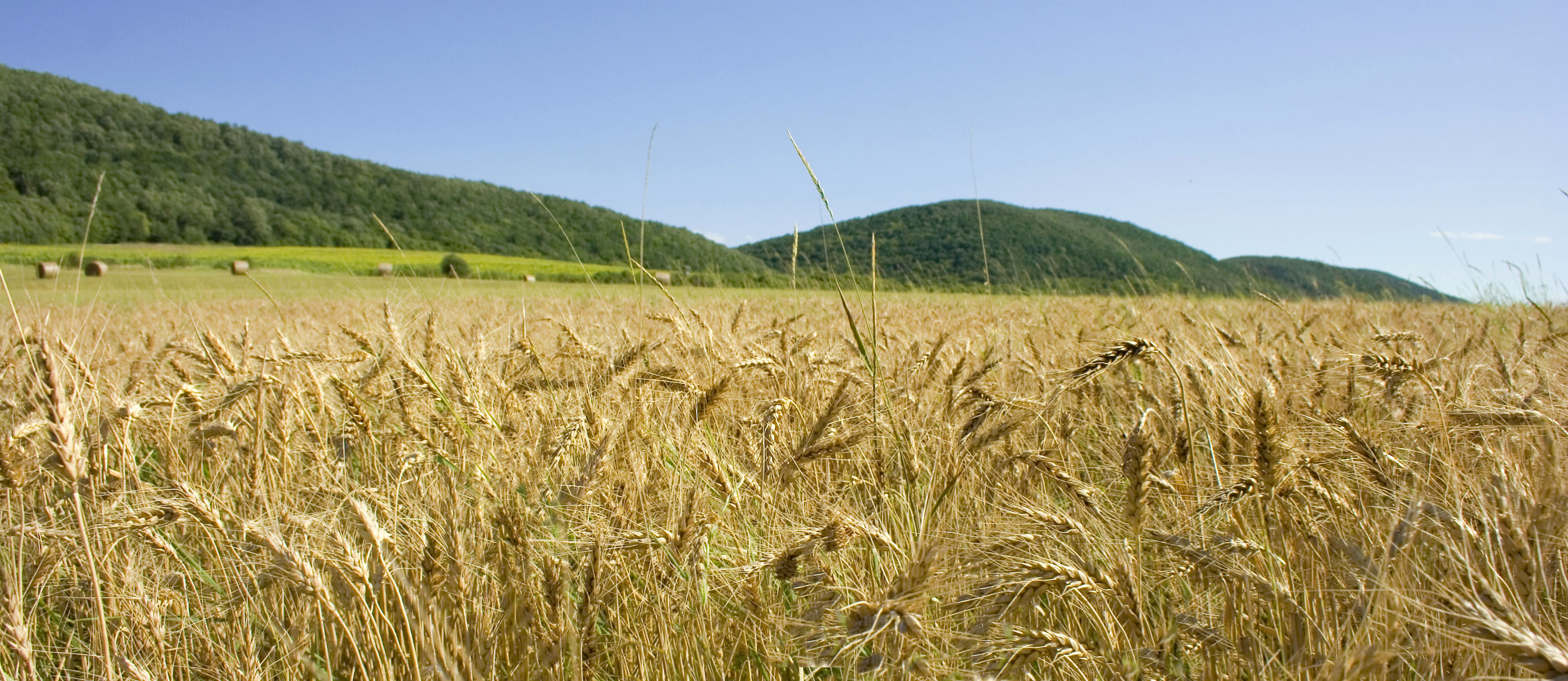
Have any of you seen wheat in the ground? I love driving through the farm fields of western Minnesota in the month of June, when all the soybeans, corn and wheat are in the ground, and the trees are all green… It’s like driving through a giant green carpet. Or in August, when the wheat is in its prime, and those ‘amber waves of grain’ start flowing in the wind.

Wheat and weeds. Harvesters ask if it’s okay to take the weeds out, while they’re still young. No, says the farmer. By uprooting the weeds, so too would you uproot the wheat. Don’t take it upon yourself, he says. It's not up to you.

Wheat for many is a staple in grains, cereals, breads, pastries, etc. It’s a versatile plant, with many uses at home or on the farm. However, it might as well be a weed to others, as there are those who cannot digest the gluten within the wheat, properly. Wheat means life for many, unrest for others.

The symbol we use as our identifying mark as Christians, is a cross. A cross, the torturous device that thousands died upon, including our savior. As Christians, we use this symbol as a rallying identity, the proof that the device used to cause death, is a reminder of our life in Christ. And yet, the cross is still used as a weapon to this day. Physically burned, or figuratively as a symbol of a broken religion, separating those whom some deem unworthy of that life in Christ.

Wheat and weeds. What some may think is unworthy of eating, others may see delicious food. A literal example of this is the common dandelion, a weed that sprouts nearly everywhere, and sticks around. While maybe a nuisance, the plant has been used as food, and herbal medicine. Kale - once thought as mere decoration for salad bars, is now all the rage, to the point McDonald’s is putting it in their burgers. You know you’ve made it big when McDonald’s sells it.

Society as a whole, puts nearly everything on a binary scale of acceptable or not acceptable. Wheat or weeds. Female or male. Queer or straight. Rich or poor. Healthy or unhealthy. Fat or skinny. Good or bad, sin or salvation, law or gospel. Some find identity between these binaries. Some bristle at the thought of such a thing.

But what does Jesus say in this parable? In this ‘throwing around’ of conversation about God? Who are the wheat, who are the weeds, what practices are wheat-like, which are weed-like?

I’m gonna let you in on a little secret. There’s room for the middle. Because what Jesus is getting at - is not that the wheat survives and the weeds burn… but within the combining of the wheat and weeds… it’s not up to you to decide what is and what isn’t. There’s wheat and weeds inside all of us. We are all sinner and saint, all maintain law and gospel.

“We know that the whole creation has been groaning in labor pains until now; and not only the creation, but we ourselves, who have the first fruits of the Spirit, groan inwardly while we wait for adoption, the redemption of our bodies. For in hope we were saved. Now hope that is seen is not hope. For who hopes for what is seen? But if we hope for what we do not see, we wait for it with patience.” (Romans 8:22-25 NRSV)

Paul the Apostle, writing to the Romans, writes of the difference between living for the Spirit, and not our body. Spirit over body. Wheat over weeds. We have hope for work of the Spirit, that which is not seen, for that is the hope on which to hold.

Hope… the fine line between what is and what could be… that is where God is present. In the space between. Hope, faith, belief - the space between what is, and what is possible. Live for what is possible. The possibilities of life abound.

When two separate incidents happen with similar results, and a consequence of both events is the ending of a relationship, what was it that ended the relationship? Something in that middle period. Was it the wheat? The weeds? What caused the end? Something in the middle.

When Christ lived his life, teachingpreachingfeedinghealingwashingsaving all, and then dying on that cross, that symbol of both death and life… Was it the weeds that caused his death? The wheat? Or was it something else? Is it the wheat or weeds that give us new life with Christ? Or is it something else?

Grace. Grace through faith. It is Grace through faith, freely bestowed on us all, to save us all from making the choice between wheat and weeds. To save us all from the weeds that hold us back from the wheat that gives us life.

What the weeds are in your own life, what the wheat is in your own life - that’s up to you. Watching Marvel’s movie Dr. Strange the other day, the main wise character of the movie, the Ancient One throws in a little tidbit that has stuck with me. Talking to Dr. Strange’s compatriot, she says “We never lose our demons... We only learn to live above them.” Sin remains, we are never sinless beings. We learn to live in the middle between sinner and saint. We have faith in a Savior that saves us from our sin, and hope in that Savior that we can learn to live above that sin. We are people, of a broken humanity, bound by both wheat and weeds, holding on to the space between. God is present in the middle. God carries us through the middle periods of our lives. Life is made up of more than wheat and weeds. Entire giant green carpets of God’s beautiful creation exist, and we are made better for it. Go out and enjoy it.

Amen

Monday, July 10, 2017

Rest.

This is my second sermon preached at Camp Nidaros, a pastor's retreat area next to my previous internship site in rural Otter Tail County. A beautiful day under the clouds and trees, next to Otter Tail Lake and Walker Lake.

Psalm 145
Matthew 11:16-19, 25-30


Grace and Peace to you from God our Creator and from our Lord and Savior Jesus the Christ, Amen

“Come to me, all you that are weary and are carrying heavy burdens, and I will give you rest. Take my yoke upon you, and learn from me; for I am gentle and humble in heart, and you will find rest for your souls. For my yoke is easy, and my burden is light.”

Christ the Shepherd of us all, the advocate for all the lost sheep… is telling us all to rest. After summoning the disciples, telling them that he came to bring a sword and not peace, to break up families, rend father from son, mother from daughter, etc etc etc… Jesus the Christ, who has been busy telling us what we are called to do in this world… tells us in our Gospel for today… to just go ahead and cool down. Put on the brakes. Stop and smell the roses.

Rest.

It’s hard to remember to stop sometimes. Those of you who are retired, those of you who need to actually retire, those who are taking the summer off, taking the day off, taking the morning off… taking this sermon off… Rest.

It’s certainly a huge difference from what Jesus had spent the last few weeks talking about. Culminating all of this discussion of what he is calling us to do… to finally say - Rest.

Life can be like that sometimes, when you just rush and rush and rush and then… stop. I’ve heard people tell me that when they work too hard for too long, something goes wrong, and they are forced to stop working. For a few clergy-folk, and it certainly wasn’t only one who’ve confessed this to me - but for those who work too hard for too long, as clergy are wont to do… a major attack on their body is the thing that forces them to take things slow. Usually it involves the heart or blood flow. Working hard and long for extended periods of time can wear a person down, and it’s not just clergy that do this, but plenty of hard-working people do. Our society demands it of us. Parenting, especially for new parents, can be quite taxing on people. School events, sports, then throw on church… self-care… When’s the *rest* supposed to happen again?

Self-care is a terrible habit to get into. Especially when juggling so many balls at once. It’s just one more ball to throw in the mix. And when you finally have the opportunity to just focus on yourself, you feel guilty for doing so. Vacation and retirement are great examples of self-care, as long as you can somehow manage to not think about work. Even now, I’m technically ‘off’ this weekend, and here I am up here. Don’t worry, I feel honored and love being here. But I’m technically ‘working’. And I had a wedding on Friday.

Just to catch you up for those of you who know me, and even those of you who don’t - It’s been a year since I was preaching under these trees, next to these lakes. I’m Jon Rundquist, the former intern of Zion, up the road. I’m currently serving my second internship at Living Waters Lutheran in Sauk Rapids and Lutheran Church of Christ the Redeemer in south Minneapolis. I’m on this second internship due to being postponed in my Approval for ordination. The second internship was part of the recommendations of the postponement. Since I left Amor last August, my family and I have been living in Saint Cloud, where I finished my Master of Divinity, and Tiffany started and finished her Master of Social Work. Raising two kids, working at Target occasionally, Tiffany working her unpaid internship, and on top of all that, I came out as transgender and non-binary in the fall. It’s been a very busy year, and I’m still going.

For some of us, rest doesn’t come by easy. For Jesus, rest doesn’t come by easily for him either. From the moment he hits the ground running, he doesn’t really get a moment to rest. He gets one opportunity to rest in a boat while the disciples are fishing… and then a storm comes and he needs to save them from that anyway. He's got so much in his plate, and yet here he is telling us all… to rest.

But it's hard these days. A new crisis erupts over night, even when we're resting, somebody else is using their device to destroy someone else's life and reputation, or complain about random things or insist that they're more popular than others or incite violence or not do the thing they're supposed to do when everyone else… is resting.

Another act of injustice. Another attack, another life taken, another reason to stand up and say- enough is enough. Every day we get up, there's something to work on, something to fight, somebody to correct, something to cry out for… and still Jesus says… rest.

For his yoke is easy, and his burden is light.

 A colleague of mine asked on Facebook what they could do to help ease the burden of caring for patients in their chaplaincy work, to help center themselves. When I feel overwhelmed, anxious, out of my element…. I seek the one element that binds us all together. I pray. I seek the One who offers us rest and I pray. Because I know and have faith in God, that God's got this.

God, the Creator of all things, of these rocks and trees, lakes and rivers, you and me…

God's got this, because God's had us in God's loving arms since before the lights were in the sky and long after they go out. As the psalmist writes in today's psalm, God endures throughout all generations, Jesus said he is the beginning and the end.

God calls us to care for God's creation, to advocate for the marginalized, to love one another, to upend the status quo, to lead by Christ's example, to keep the faith, extend the faith… and rest.

And when you have rested and begin to be restless, start again. Keep up the good fight. The sun will shine tomorrow.

For his yoke is easy, and his burden is light.

I cannot end this sermon, without addressing the elephant in the room… or trees…
Jesus the Christ offers us with this text, a promise of the ultimate rest, the ultimate laying down of burdens at his feet. There is no life without death. But because of the One who conquered death, there is no death without life. Through the unwinnable and unshakable never-resting power of God's Grace, freely bestowed to all through Christ's life, death, and resurrection… in the Cross, we find our eternal rest.

 Through all the joys and sorrows of life, the fighting of injustices, the daily grind, the working and over-working, the chaos of modern realities… remember to rest. We have confidence and boldness in Christ, knowing that through it all, God's got this.

Amen