Friday, January 10, 2014

In a Box, High Up on the Shelf

I'm not gay, but I was in 5th Grade when I was first called a fag. Before then, I was picked on for my underbite, my rockin' hand-me-down sweatsuits, my less-than-stellar appearance, whatever. Fifth Grade was the first time my sexuality was questioned by a classmate. Fifth Grade was the year I lost my cousin and my paternal grandmother. Fifth Grade was the beginning of my activist life.

Before then, I had little knowledge of what sexuality was. Fifth Grade was the big year where boys got to learn what boys had downstairs and girls got to learn what girls had downstairs. (Sixth Grade was the big year where boys got told what girls had and girls got told what boys had) Of course the videos were corny and outdated. Of course everyone was awkward and inappropriate about it. Puberty happens when it happens.

I was nice. I wasn't an asshole. I wasn't a jock who cared about sports. I was smart. I loved learning about space and science. I loved the little trivia games we had. I loved playing oboe (a "girl's instrument") in band (I never practiced, but I loved playing it). I didn't pick on anyone, I made dad-jokes even then. Somehow, all of that, meant that I was gay. When it happened, I did what every curious child would do. I looked the word up.

When I looked it up in a dictionary (before wide use of the internet), this is similar to what I saw:


So, I wasn't a schoolboy in Britain, or anything pertaining to one, and I wasn't a cigarette. It led me to the last definition and thus the following word, Faggot. There it was, right underneath. Faggot: A male homosexual. (can't be female of course...)

Fifth Grade. My sexuality was first questioned when I was too young to understand why.

From then on, it was continuous. As I grew up, the teasing didn't stop, they were just more inventive. Butt Pirate was my favorite... There was a kid from Texas who would call me a gay fucker in Spanish. There were kids of all ages calling me a gay fucker. I knew I wasn't, so it didn't make sense to me why they knew something I didn't. There were cute girls, and I had long-lasting crushes on a few of them, but I never asked any girls out until much, much later. We lived 10 miles away, I was too young or unable to drive, and we were poor. There was no point.

California Sunrise... In January...


My parents divorced and I moved to California with my younger brother and my mother. I joined choir, and met some really cool folks. After our first choir concert, the nice ones asked if I would like to go out to Denny's with them. It was the first real social engagement I had had with multiple people who weren't related to me. So I went out with them, and during the conversation, one of them asked what I thought of gay people. I told them that they were cool ordinary folks and I kinda knew a couple from working at McDonald's... They nodded and went on talking, and then a note came to me and it said, "Bryan's gay." Oh. I smiled. It was then that I knew I was in. I was cool. I was a trusted friend, and that knowledge was good.

From that point on, I had a trusted friend that was part of the LGBT community. It was then that I knew I had to fight for their rights alongside them. That was when I proudly wore my 'ALLY' Button on my heart (figuratively of course). Gay was no longer a label of fear, but a friendly, smiling face. I wasn't gay, but I had a trusted friend who was, and that was important to me.

Remember that dude?
I moved back to Morris a changed man. It seemed everybody grew up my senior year. That is until... Facebook. Facebook suddenly became available to those without .edu emails. (which is how I acquired one, but I still had to be invited from a current facebook user...) One of my classmates made a pro-life note on facebook, and it sparked a discussion in the comments. A LONG discussion... about 40 comments until... Someone threw in a homophobic remark... and then another... and another flurry of comments went flying by. Half of the upperclassmen were in this discussion (okay, maybe not half... but a lot) My Senior Class President, the representative of all that is good for my class... said something to the effect of, "all those gays better leave the country" or something...

Either way, the discussion was printed out and given to the principle. People were talked to, but no recourse was done. Then, sometime in the course of that year, the liberal kids showed up in school with shirts from UMM that said, "Gay? fine by me..." Which of course provoked the conservative kids to show up wearing shirts that said, "Gay? NOT fine by me..." Both shirts were soon banned from the school... Soon after that, I started placing DFL and LGBT-Ally propaganda on my locker, above my locker, anywhere for people to see that I was lamb in a pack of wolves. I wanted to get out of that town, and get on with my life...

Christmas Day 2009

Life... funny how it all worked out. I bounced around for a few years after graduation, and wound up working at the Flying J Truckstop in Fargo. I was a server in the restaurant (above) there for a year or so, and whilst I was there, I met a handful of lovely colorful characters. I also got to hear all the conservative banter from all the truckers. One night, I was alone up front with no customers when a driver came barging in.

"Are you the only waitress?", he exclaimed. "No," I said, "I'm a waitER, and yes, I'm the only one." He replied, "NO, you're a WAITRESS, you're working up here, you're a WAITRESS." "Alright sir," I sighed, "I'm the only server yes. What can I get for you?" He huffed, turned around and proceeding to stomp out of the restaurant. He met my coworker, a female server at the door, and talked with her for a while. Then, he left. I heard later that he complained to both my coworker and to the C-Store next door about how the restaurant DARE hire a fucking faggot. How DARE they allow one of THEM to work. I was so mad... I went to the back room and yelled. A lot. I almost quit. I saw the man again, a few times. I wasn't allowed to serve him, for fear I might 'get the gay on him' or something... The manager never kicked him out...

I'm not gay. I have wonderful, brilliant and inspiring friends in the LGBT community. I fully support, fight for and insist on their full rights guaranteed to them and every other person in this country. But that's not what I'm getting at. That's not why I'm telling you these harrowing tales. I'm telling you because I can't tell my youth. At least, not yet.

You see, I feel it is very important to inform my youth about this, because I'm sure they or their friends have been picked on. I'm sure they know of someone who's been bullied for something they're not. And I know they hear the conservative rhetoric about LGBT folk, especially after the Duck Dynasty crap. It's current, it's relevant, and I wanted to talk to my 7-12graders about my stories and what the Bible really says in the 4 or so verses that mention something resembling homosexuality. But I can't.

It was suggested to me that I need to be obedient to the church. I need to learn my context, and feel it out. I need to take it slow. I was told that I can't be put in a box like I should be. That little box on the Shelf... My point, my friends, is this, and it's a recurring theme: Can my past experiences be put in a box, high up on a shelf... all for the sake of my church? Does my calling hinder my past? Where do my advocacy and activism boxes go? When does doing the right thing take a side to... political pressure?

CAN I NOT BE MYSELF?

CAN I NOT ADVOCATE AND FIGHT?

Where is the line between right and wrong when I cannot do the right without being in the wrong? I feel like I'll face this dilemma frequently in my future calling... The church is meant for more than playing nice.

One last thought: I think I've told this story before, but I think it's prudent now. My rabbi always told the story in class about the time in his rabbinical office when a man asked him if the rabbi would accept the man for his homophobia. If the rabbi was so accepting of LGBT folks, would he accept the man for being homophobic. He never told the end of that story, and I think that's the point. It's always the question. We must seek the answer, but probably never receive it.

Amen


Sunday, December 29, 2013

Honey Smoothies

For this blog post, I give to you my sermon from this morning (which also happens to be part of my Pentateuch final). I went off the lectionary, because honestly, I preached about the slaughtering of the children last year (and it's rather a depressing text), and I wanted to not let a fine sermon used for a final go to waste. We had to use a text from the Pentateuch for my final, so I picked Numbers 20:1-13. It's only found in the daily lectionary on a random Tuesday or something... It's one of my favorite stories, and you'll soon find out why. And every good sermon must have a Gospel somewhere, so I went with Matthew 6:25-34. An oldie, but a goodie...

(You get the added benefit of pictures) (for it is a blog after all)


Do we have to? Are we there yet? Can we listen to something else? He keeps elbowing me… All of us have been there. Stuck in the backseat with your smelly brother on a long car trip over the river and through the woods to grandmother’s house you go... Okay, so maybe you don’t all have smelly brothers. Maybe you don’t all have smelly sisters. I don’t have any sisters, but I’ve had enough car adventures with my smelly brother to know that it stinks, BOTH figuratively and literally. That point where the smell starts giving you a headache; the air conditioner (or heater) isn’t working well enough and you start to sweat profusely (or shiver profusely) (let’s face it, you’re never comfortable in the backseat) until you can’t take it anymore. You cry out with as many complaints as possible, because you’ve had enough of your tight quarters next to your smelly brother.
           

Your dad yells from the driver’s seat, “Cut that out, or I’ll pull over and you can walk the rest of the way!” (Knowing that he was merely threatening; that there was no truth behind it.) (Or, at least you hoped.) So, you sit back and endure the rest of the trip, next to your smelly brother. But, maybe you’ve been that father, or mother, who has said such things to your children. (Even though you were merely threatening, but there was no truth behind it.) (Or at least they hoped.) Stress makes us do crazy things sometimes, especially in the last month or so. But, crazy enough to defy God’s divine will?
           
Moses had valiantly rescued the Israelites from the clutches of Pharaoh’s grasp. He guided them across the Sea of Reeds (or the Red Sea) by the thousands. God gave Moses the tablets with the 10 Utterances (Otherwise known as the 10 Commandments) not once, but twice. God gave the Israelites manna; promised them a land flowing with milk and honey (sounds sticky). Sure, they had to walk around in the wilderness for 40 years, but God had set aside a land just for them. A land flowing with milk and honey (still sounds sticky) and they had had enough. Their feet were tired, their livestock were dying (probably stinking up the place), they had no fresh fruits (sounds like Minnesota right now), and most damning of all, they had no water. Stress may cause you to do some crazy things, but dehydration is a whole other animal. We’ve all seen the movies of people walking forever in the desert and seeing mirages (Spaceballs comes to mind), doing and seeing anything to get water. But, defying God’s divine will? That may be going a bit far, don’t you think?


After Moses and Aaron had heard enough whining, they went to the tent with the Ark, and asked God for wisdom. God commanded that Moses was to speak to the rock in front of the Israelites and it would bring forth water. Crazy eh? It’s like squeezing water from a rock… Oh wait… So Moses takes the staff, goes in front of the people, and smacks the rock. Not once, but twice. Had Moses smacked it once, it would have been a major “oops” at most. Had he smacked it once, Moses might have been able to enjoy honey smoothies with the rest of the Israelites in the Promised Land. Had he smacked it once, it would have been a mistake. He smacked it twice. Not once, but twice. Twice shows intentionality. Twice shows that the stress and dehydration have gotten to him enough that he’s done listening to God’s commands. Twice shows that Moses is fed up with wandering around and he wants results. Moses hit it twice, and thus he died before ever reaching the land promised to him and the Israelites.

            This summer, I had the blessed opportunity to traverse the land of our northern neighbors with New Wine. During the trip, I would overhear some youth saying things that were racially and religiously offensive. I told them this story of Moses. I said, this is what you said, this is why it’s offensive, and now you know. You are no longer ignorant about it. That’s your first strike against the rock. The second strike, I get to yell at you. This way, they learn a bible story, they learn why what they said was wrong and offensive, and it gives them a chance for redemption. However, once they are no longer ignorant of the offense, and I catch them saying similar things; that shows intentionality. Once you get pulled over for having a headlight out, you can’t blame ignorance if you get pulled over again.

I learned this rhetoric from my rabbi, Joseph Edelheit, the Director of Jewish and Religious Studies at Saint Cloud State. He uses it when he hears students say offensive things, and thus I adopted the practice. I think it worked well this summer, and I will continue to use it. Hopefully, I won’t have to all that often.
           
            And yet, there’s still something missing… My brother Erik is completing his final year at Wartburg Theological Seminary, and he’s always vigilant when listening to sermons. Where’s Christ JoN? Where’ the Gospel JoN? Where’s the Gospel in such a LAW LAW LAW text? DON’T DISOBEY GOD. HE WILL TAKE AWAY YOUR HONEY SMOOTHIE.


A couple books before this text, when Moses goes atop Mount Sinai, he receives the 10 Utterances from the Lord. Moses comes down the mountain to see that the Israelites had DISOBEYED GOD and made a golden calf idol. They were worshipping this golden calf. God threatened to wipe them off the face of the planet, but Moses pleaded with God to stay God’s hand. Moses asked if God had led them out of Egypt, then why was God so willing to slay them after this offense. God saw Moses’ reasoning, and decided to not destroy the Israelites. LAW LAW LAW. Where is the Gospel? For that, we have to look at the whining. We have to revisit the smelly brother.


            In the Gospel of Matthew, Jesus is preaching the Sermon on the Mount. Blessed are the cheesemakers and such… But towards the end in Chapter 6, Jesus utters these words,
            ‘Therefore I tell you, do not worry about your life, what you will eat or what you will drink, or about your body, what you will wear. Is not life more than food, and the body more than clothing? Look at the birds of the air; they neither sow nor reap nor gather into barns, and yet your heavenly Father feeds them. Are you not of more value than they? And can any of you by worrying add a single hour to your span of life? And why do you worry about clothing? Consider the lilies of the field, how they grow; they neither toil nor spin, yet I tell you, even Solomon in all his glory was not clothed like one of these. But if God so clothes the grass of the field, which is alive today and tomorrow is thrown into the oven, will he not much more clothe you—you of little faith? Therefore do not worry, saying, “What will we eat?” or “What will we drink?” or “What will we wear?” For it is the Gentiles who strive for all these things; and indeed your heavenly Father knows that you need all these things. But strive first for the kingdom of God and his righteousness, and all these things will be given to you as well.
 ‘So do not worry about tomorrow, for tomorrow will bring worries of its own. Today’s trouble is enough for today. (Matthew 6:25-34 NRSV)

            When I was younger, I was always worrying. I seem to have grown out of that because my wife, Tiffany insists that I don’t worry enough anymore. But when I was younger, my father noticed this and shared with me his favorite verse. “So do not worry about tomorrow, for tomorrow will bring worries of its own. Today’s trouble is enough for today” (Matthew 6:34). So this text has become a marker for me. I cling to the wisdom it holds, and perhaps that is why I don’t worry as much as I should.
            So maybe Jesus has a point. Maybe we shouldn’t worry too much. That smelly brother isn’t going anywhere, and there isn’t much you can do about it. All you can do is sit back and relax as best you can. I had a choir teacher in high school that got tired of us whining all the time. He proudly proclaimed once, “Life sucks, so get over it.” Not very consoling to a high schooler…
            Instead, take consolation in the fact that things will hopefully, eventually get better. The car ride will end, and fresh air can be felt again. The sun will rise on a new tomorrow, and God is there, walking with you. Smacking the rock twice may garner consequences here below, but all are welcome at the Lord’s Table, with plenty of honey smoothies to go around. Merry Christmas.

Amen.  

Friday, December 20, 2013

Out of the way, it's a busy day... I've got things on my mind...

So, I'm sorry it's been a while since I have written a blog post, (before Thanksgiving in fact) but as the title suggests, I've been busy. After Thanksgiving with Erik and Rachel, finals were in full swing and life happened. It's a busy time of year for all of us, and even now, I'm squeezing in a lunch with Pastor Todd of Living Waters Lutheran in Sauk Rapids before he leaves on a trip to a foreign land. I'm currently waiting for him to finish his pastoral duties before we can eat, so here I am, squeezing in this blog post while I have a few minutes.

It's a busy time of year. Finals are finished, tomorrow will be the shortest day of the year (well, okay... all days are 24 hours long, but tomorrow has the shortest period of daylight) and Christmas is upon us in a few days...

Ahh, Christmas. That magical time of year where we get to open presents, see family, and share this holiday cheer...

I had the blessed opportunity to give a devotion at a senior care facility in Maple Grove yesterday as part of my pastoral care education through my current position. I couldn't really think of anything to say right away, but then it came to me, and I'll share it with you now.

A Christmas Card from long ago...


I told them that when I'm in stores or the mall this time of year and I hear "Mele Kalikimaka" or "Christmas in Killarney" over the radio, I have powerful memories come over me. I remember that when we were young(er) and celebrating Christmas at the Grandparents' house in Saint Cloud, all the cousins would gather round and dance to those songs. My grandfather would be sitting there in his chair with his holey socks and overgrown legs, waiting to catch one of us in case we fell (or maybe to capture us to wrestle with us in his chair) (he had super long arms and could reach us from almost anywhere) and my grandmother in her seat on the couch.

Every time I hear those songs, those vivid memories of those Christmases invade my being, and I am overwhelmed. I told these elderly senior citizens that these overwhelming memories of long past loved ones are God's way of tapping us on the shoulder as if to say, "it's okay. They may be gone now, but they'll always be with you." They'll always be with us, in our memories; in our stories. 

Christmas is a blessed time of year, and let us all remember the good times. Let us also then create new ones with our loved ones, so that we may look back on these days filled with strife more fondly. 

Merry Christmas, and God Bless us, Everyone.

Amen

Saturday, November 23, 2013

Thanksgiving and Leftovers

(DISCLAIMER) Like most things in life, better things usually come later. Please read until the end before making judgement on the following...

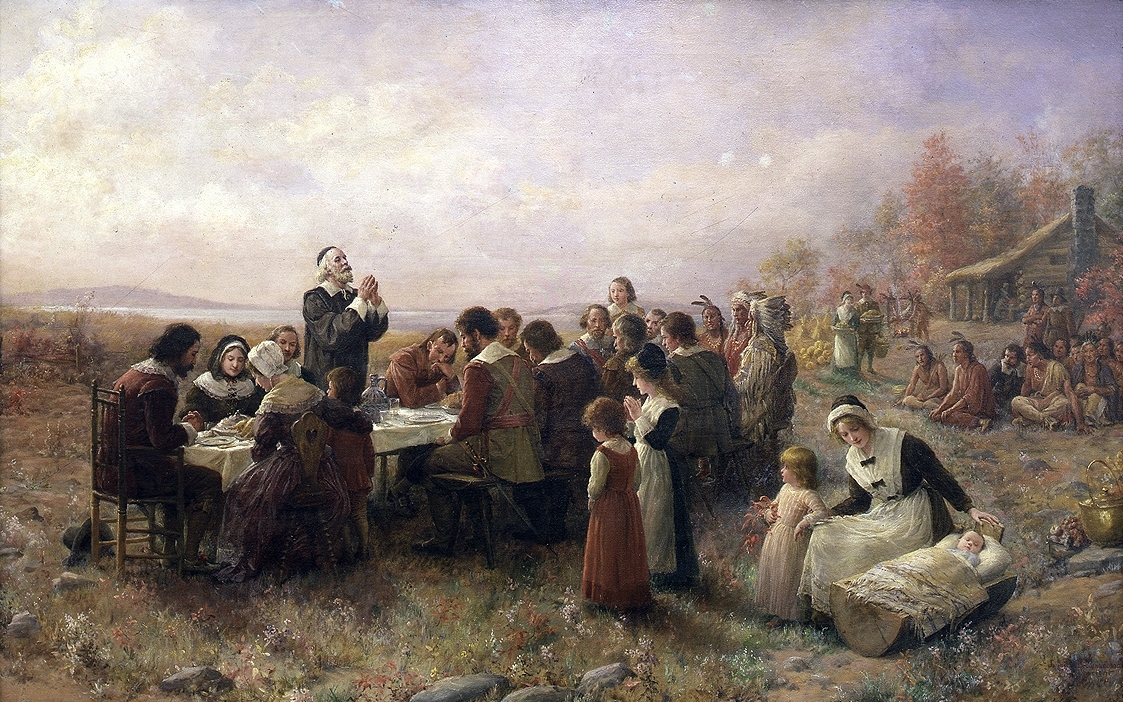
No Stuffing at the First Thanksgiving... Just the way it should be
Rejoice always pray without ceasing, give thanks in all circumstances; for this is the will of God in Christ Jesus for you. - 1 Thessalonians 5:16-17 (NRSV)

Thanksgiving. It's less than a week away. Well, at least for us Americans. Our neighbors to the north, those silly Canucks, had their own Thanksgiving a month ago (October 14th to be exact). Tiffany, Sam and I are headed to our neighbors to the south however, to the land of those silly Iowegians, better known as Iowa. My brother is finishing his final year at Wartburg Theological Seminary and thus, it is our last (and first) chance to go visit him whilst he's down there. Thankfully, it's not too far.

Thankfully, Sam is old enough to not freak out too much on long car rides anymore. However, after this Christmas, I think the fam and I will let everyone come to us for holidays. I think we'll just stay home for holidays from now on, wherever that home may be. I'm thankful we have a home to stay home in.

However, thankfulness is something that I need to work on. I seem to have let some thankfulness slip over the years. I remember having to write Thank You cards after Confirmation, Graduation, Wedding, Baby Shower... and then neglecting to do so for the Confirmation and Graduation. Having to be reminded constantly was really... saddening, even though I still didn't do it. Why was I reluctant to Thank people? Why are we reluctant?

I was reluctant this month to thank the Luther Seminary donors for my scholarship. Yes, I received a scholarship to come here. I was awarded it this spring when I met a few of my current classmates for the first time. There were about 20 of us; we were all promised a scholarship, and told there were multiple FREE RIDE scholarships. I had my hopes, dreams and sights set on one of those FREE RIDE scholarships. Why not hope? Because I'm not THAT special. That's why not.

I should have known that the lowest possible scholarship was going to be mine, and not bothered to hope for anything more. Yes, I got a scholarship, but it was the lowest possible scholarship they offered. When I first heard that I received the scholarship, I was hurt. I worked so hard, tried my darnedest in the entire process, and I got the leftovers. I was more hurt than thankful, when I should have been overjoyed to hear such wonderful news. Many of my classmates had no such scholarship. Some received better ones, some received FREE RIDE scholarships. I got the leftovers.

Even the leftovers say "Thank You"
I see these FREE RIDE scholarship winners everyday, and I have to ask myself why they got one and I didn't. What was different about them? What special qualities did they have that I didn't? Could it be that they were able to be much more active in school and have better grades than I because they didn't start a family in the middle of college?

If they had based it on economic need instead of grades and activities, I might have been able to get a better scholarship, maybe even a fabled FREE RIDE scholarship. However, it seemed their priorities were stacked against me, and I'll have to be alright with that. I'll have to be thankful for those leftovers.

It's sometimes hard for us to thank people for stuff we don't feel thankful for.

It's hard to thank the great aunt who gives you a loaf of bread for your birthday.
It's hard to thank the ex-girlfriend who gives you a coloring book for Christmas.
It's hard to thank the new mother-in-law of your recently remarried father for pajamas.
It's hard to thank the donors for a leftover scholarship.

It's hard to thank sometimes. But it doesn't mean that we shouldn't.

I know I should have thanked the donors, I just... didn't make it a priority.

It's hard sometimes, when I really am thankful for things, and I can't contain my gratitude. How can we differentiate so much on what we are thankful for?

It's easy to thank God for family.
It's easy to thank God for friends.
It's easy to thank God for the food on our plates.
It's easy to thank God for the life we have.

It's easy to thank sometimes. But it doesn't mean that we shouldn't.

So what about those leftovers?

Oh yeah... those leftovers...

I received a scholarship. $500 a class/year. It's not a FREE RIDE but it's enough to make a difference in my financial aid. And I should be thankful for that. I am. I am thankful for the scholarship, however the donors will never know that due to my... delayed gratitude...

So this Thanksgiving, and every Thanksgiving... When you're given the leftover canned cranberry sauce, the organ meat of the turkey, the burned pecan pie, the mushy stuffing, just say "Thanks". You may not want it; you may be overjoyed with it. In any case, be thankful. 

There's a lot of people across the world, across the nation, across the state, across the road... That have less, that are given less...

There's a lot of seminarians at Luther that have less, that are given less... 

So be thankful. 

Amen.


P.S... Thoughts on paying for seminary (with or without a scholarship and financial aid), and paying for education in general will addressed next time... Until then, Happy Thanksgiving!

Friday, November 8, 2013

Something Better

For most of today, I've been busy (finally) working on my application for my CPE(Clinical Pastoral Education) experience this coming summer. The application has made me think of a lot today, including of friends, mentors and old memories long forgotten. One of the questions was asking about a situation where I gave help to someone who asked. It took me a bit, but it finally reminded me of a time last spring.


One night last spring, my son Sam and I were returning home from Riverside Park in Saint Cloud. I saw a man in a motorized wheelchair pulling a cart full of stuff. The man was only dressed in a hospital gown and hospital socks. It was evident that the only possessions the man owned were in the cart behind him. He was making his way out of the bathroom when I saw him, and I was putting Sam in the car when the man drove his little chair in front of my car, and asked for my help. I told him that I was busy putting my son in the car and I was unable to leave Sam in the car alone. He insisted that I needed to help him put his bag of stuff back in his cart. I felt God’s anthropomorphic metaphorical finger tapping me on the shoulder, so I drove my car right up next to the bag so I was never ten feet away from Sam. The bag was a large cloth sack filled with assorted things and a large TV. The TV was the culprit that fell out his cart, so that was the heaviest and hardest to move. I finally grappled with it and placed it back in his cart. I nodded to the man and I got back in my car to head back home. Sam and I were almost out of the parking lot when I looked back in my mirror at the man to see the bag of stuff to fall out again.

Rather than drive away ignoring what I saw (which I really wanted to do) I turned around, and proceeded to repeat the grappling I just did 5 minutes prior. This time, I made sure that the TV was snug in his cart, told him to take turns slowly next time so that it didn’t fall out again. I nodded at him again and returned home. I returned home to my apartment with plenty of food on the shelf and in the fridge. I returned home to my computer, HDTV, and loving family. I struggled for a few days trying to find the justice in that. How did I have so much (and it’s not much compared to some) and he have so little?


I reluctantly helped the man move all of his possessions in the span of 5 minutes of struggling with a TV and other assorted objects. It took two days of packing, moving and unpacking to move all of our stuff from Saint Cloud to Seminary. It took me 5 minutes to move his 2 feet. Makes one think…

I helped him that one time (two times, technically). I'm sure his bag of stuff has fallen out of his cart multiple times since then. There are people like me who are (reluctantly) willing to help, some who aren't, and some who selflessly help without even thinking. 


I've been studying Christ Lutheran on Capitol Hill as part of a group project in a class. The church is literally located a block behind the State Capitol. Every time I drive down there, I inadvertently drive by a number of people pushing their own carts full of stuff. Every time. Blocks from the steps of the State Capitol, where a giant beautiful gold-plated statue stands guard above. The State Capitol, where politicians have the power to eradicate poverty in this state. A church stands on the corner. This church, Christ Lutheran, has many programs helping these individuals, but it's not enough. 

Growing up as poor as we did, we were thankfully never on the street pushing our own carts. I don't think we were ever close, but I do feel closer to the people pushing the carts than I do to the people driving fancy cars in multiple large, lavish houses with car elevators. There has to be a better way to do things in this country. There has to be a better way of living out God's mission in the world. 

I don't know how to do it, I don't have the resources to do it, but I wish to strive for something better in this world than this. I think the only way this can happen is with the Church's help. That's a capital C on that Church. And I'm not implying merely the Christian church, but as a pluralist, I mean everyone who believes in a divine being that knows this isn't right. 

We weren't meant to merely feel bad for these people.
We weren't meant to merely give our money to these people.
We weren't meant to merely feed these people for one night.
We weren't meant to merely preach against the injustices.

We are meant to do something about it.
We are meant to fix the injustices.
We are meant to fight for these people's lives.

Let's do something about this people. I don't mean merely helping out at a soup kitchen, donating food, donating money, donating blankets (which are all wonderfully great things to do). But we need to do more. 
I don't know what. I don't know how. But there are people who do. 

I leave you with a classic song from the 90's. Eddie Vedder and Chris Cornell before they had their own bands, Temple of the Dog's Hunger Strike.


Amen. 

Friday, November 1, 2013

A week before the 75th Anniversary of Kristallnacht...

I'm finally posting this. Please, if you agree with the conclusion, share this. After the celebrations of Reformation Sunday and Reformation Day, please read this. I wrote this as my 'Senior Thesis' of sorts for my B.E.S degree from SCSU.


 “They are our open enemies; they do not cease to blaspheme our dear Lord Christ; they call the Virgin Mary a whore and Christ, the child of a whore.  Us they call changelings and abortions, and if they could kill us all, they would gladly do so.”
            Martin Luther (1546) An Admonition Against the Jews

We’ve Moved Past it …?
            My fellow students, spread across western Minnesota are small communities mostly populated with white Christians who have close ties to agriculture and religion. If there are any Jewish people in these communities, they are few in number. Donnelly is a small, rural farming community in the center of western Minnesota with a population of about 250 people. Spending the majority of my younger years in this conservative German Lutheran town, I attended school in the nearby town of Morris. Because of the University of Minnesota Morris, the town had a little more diversity than the average Minnesotan town of around the same size (~5,000). However, this diversity did not readily include those of Jewish ancestry or culture. My knowledge of the Jewish people and culture came from watching Mel Brooks’ movies and Jon Stewart on The Daily Show.
After starting this study about Luther and his thoughts about the Jewish people, my professor tasked me to inquire with the ELCA pastors who are important in my life about their thoughts and feelings on Luther’s writings. All of their responses were of disgust for the writings, but with the same conclusion: The ELCA wrote an apology in 1994 and we work together with our Jewish brethren for the common good, so therefore we’ve moved past these writings. The website of the ELCA (elca.org) shows nothing regarding the writings. The 1994 apology is there, and there are some passing references to “On the Jews and their Lies” in some articles, but there is no explicit mention of Luther’s anti-Jewish sentiments. So, according to my pastors and the ELCA, we’ve moved past it. Or have we? This paper will examine that question, and what I will do with this knowledge in the future, if anything.
            Growing up in the ELCA, I was told of Martin Luther’s 95 theses and the fact that he gave the people the Bible in the common tongue. I was taught in confirmation that he was a runaway monk who married a runaway nun and started the Protestant Reformation. As I grew older, I understood more about my faith’s namesake, including his responses to the Apostle’s Creed in his Small Catechism. In my high school years, my mother informed me that he wrote terrible things about Jews in his later life when he was dying of uremic poisoning, but I was never shown what he wrote. It wasn’t until I took classes at Saint Cloud State University from my Religious Studies professor, Dr. Joseph Edelheit (who happens to be a rabbi), that I was shown these terrible writings, and I was in disbelief at the extremely horrific details Luther was so specific about. Using Schramm and Stjerna’s Martin Luther, The Bible, and the Jewish People: A Reader in my class, I learned that Martin Luther did write terrible things in his later life, partially due to his health, but that his anti-Jewish sentiments were prevalent throughout his teaching and writing career, even before hanging the 95 Theses on the door of the church in 1517.

“For their recta stick out, that is, the innermost feelings of their heart and their desires in opposition to Christ they display to the present. Through these they have poured out their excrement. Therefore, the recta sticking out means that their will to harm and do evil appears, since they are not able to vomit the feces of evils against Him.”  (Martin Luther, First Psalm Lectures (1513-1515))


Part of my difficulty with Luther’s anti-Jewish texts is that at the same time Dietrich Bonheoffer, a Lutheran theologian and pastor, was writing against the Nazi’s eradication of Jews and saving them from their persecution, Adolf Hitler was using Martin Luther’s “On the Jews and Their Lies” as proof of Jewish evils.  Is this a case of “Do not let your left hand know what your right hand is doing”? If Bonheoffer had known that Hitler was using Luther’s writings as justification, would he have remained Lutheran? While Bonheoffer was using Luther’s words of love and social justice, Hitler was using the most difficult anti-Jewish passages of Luther’s writings:
“First to set fire to their synagogues or schools and to bury and cover with dirt whatever will not burn, so that no man will ever again see a stone or cinder of them. This is to be done in honor of our Lord and of Christendom, so that God might see that we are Christians….
Second, I advise that their houses also be razed and destroyed.
Third, I advise that all their prayer books and Talmudic writings, in which such idolatry, lies, cursing and blasphemy are taught, be taken from them…. We must not consider the mouth of the Jews as worthy of uttering the name of God within our hearing. He who hears this name from a Jew must inform and chase him away. And may no one be merciful and kind in this regard.
Fourth, I advise that their rabbis be forbidden to teach henceforth on pain of loss of life and limb…
Fifth, I advise that safe-conduct on the highways be abolished completely for the Jews…. Sixth, I advise that usury be prohibited to them, and that all cash and treasure of silver and gold be taken from them and put aside for safekeeping ….
Seventh, I commend putting a flail, an ax, a hoe, a spade, a distaff, or a spindle into the hands of young, strong Jews and Jewesses and letting them earn their bread in the sweat of their brow… For it is not fitting that they should let us accursed Goyim toil in the sweat of our faces while they, the holy people, idle away their time behind the stove, feasting and farting…” (Martin Luther, On the Jews and their Lies (1543))
            Luther’s call to action to Christians of his day is not found in Schramm and Stjerna’s Reader; I had to find it elsewhere. The above section of “On the Jews and their Lies” was not placed in the Reader because it was “infamous” (Schramm and Stjerna p.146) and was able to be found elsewhere, and perhaps it is too horrific and embarrassing for entry into the Reader. I’ve found it to be the prime example of Luther’s writings at his worst and most horrific. It’s tragic that Adolf Hitler embraced and acted upon “On Jews and Their Lies,” beginning with what is known as Kristallnacht (Night of Broken Glass). On the nights of November 8 and 9, 1938, Nazi storm troopers smashed windows out of synagogues and Jewish-owned shops and buildings (thus Kristallnacht), killing at least 91 Jews, and sending at least 30,000 Jews to concentration camps. The Nazis destroyed 267 synagogues across Germany, Austria, and Sudetenland. One cannot blame these atrocities solely on Luther, but his above writings may have had some influence.
In the middle of his ministry, Martin Luther wrote, “That Jesus Christ was Born a Jew,” in which he, perhaps uncharacteristically, wrote words of supposed kindness towards the Jewish people.  In the calm before the hellfire hailstorm of anti-Jewish writings that were to follow, we can recognize that at one point he attempted to write some kind words.
“If we really want to help them, we must be guided in our dealings with them not by papal law but by the law of Christian love. We must receive them cordially, and permit them to trade and work with us, that they may have occasion and opportunity to associate with us, hear our Christian teaching, and witness our Christian life. If some of them should prove stiff-necked, what of it? After all, we ourselves are not good Christians either.”  (Martin Luther, That Jesus Christ was Born a Jew (1523))

Luther’s writing above was in response to the Crusaders’ murderous treatment of Jews, and as we’ve seen, not his general sentiment before or after 1523.  Conversion of the Jews was the ultimate goal, and as Phyllis Goldstein writes, “He, too, viewed ‘toleration’ as little more than enduring the presence of Jews until they became Christians.” (Goldstein, 2011)  As it became clear to Luther than conversion wasn’t happening as he’d hoped, his writings became more and more hate-filled.  
Luther’s views are in a long line of Christian thinkers who express an anti-Jewish polemic, including Saint Augustine. The Crusades, The Inquisition, and the implementation of Jewish ghettos across Europe all happened before Luther. It took well over 1900 years from Jesus’ trial until 1965 for the Catholic Church to approve Nostra Aetate at Vatican II, renouncing church teaching that Jews were/are responsible for Christ’s death: 
“True, the Jewish authorities and those who followed their lead pressed for the death of Christ; (13) still, what happened in His passion cannot be charged against all the Jews, without distinction, then alive, nor against the Jews of today. Although the Church is the new people of God, the Jews should not be presented as rejected or accursed by God, as if this followed from the Holy Scriptures. All should see to it, then, that in catechetical work or in the preaching of the word of God they do not teach anything that does not conform to the truth of the Gospel and the spirit of Christ.” – Nostra Aetate (1965)

            The Catholics did indeed take over 1900 years to denounce the ‘Christ-Killer’ rhetoric, but it also took the Catholic church a long time to denounce many of their other outdated teachings, including the location of the Earth in relation to the universe, the shape of the Earth, burning of heretics, and the like. To be fair, the American Lutheran Church, one of the precursors to the ELCA, adopted a very long document laying out how the ALC held relations with the Jewish community.  The document clearly confesses, “In America, Lutherans have been late and lethargic in the struggle for minority rights in the face of inherited patterns of prejudice. We have also been characterized by an inadequate level of ethical sensitivity and action in social and political areas.” (ALC)
The Church Council of the Evangelical Lutheran Church in America on April 18, 1994, adopted the following document as a statement on Lutheran/Jewish relations:
In the long history of Christianity there exists no more tragic development than the treatment accorded the Jewish people on the part of Christian believers. Very few Christian communities of faith were able to escape the contagion of anti-Judaism and its modern successor, anti-Semitism. Lutherans belonging to the Lutheran World Federation and the Evangelical Lutheran Church in America feel a special burden in this regard because of certain elements in the legacy of the reformer Martin Luther and the catastrophes, including the Holocaust of the twentieth century, suffered by Jews in places where the Lutheran churches were strongly represented.
The Lutheran communion of faith is linked by name and heritage to the memory of Martin Luther, teacher and reformer. Honoring his name in our own, we recall his bold stand for truth, his earthy and sublime words of wisdom, and above all his witness to God's saving Word. Luther proclaimed a gospel for people as we really are, bidding us to trust a grace sufficient to reach our deepest shames and address the most tragic truths.
In the spirit of that truth-telling, we who bear his name and heritage must with pain acknowledge also Luther's anti-Judaic diatribes and the violent recommendations of his later writings against the Jews. As did many of Luther's own companions in the sixteenth century, we reject this violent invective, and yet more do we express our deep and abiding sorrow over its tragic effects on subsequent generations. In concert with the Lutheran World Federation, we particularly deplore the appropriation of Luther's words by modern anti-Semites for the teaching of hatred toward Judaism or toward the Jewish people in our day.
Grieving the complicity of our own tradition within this history of hatred, moreover, we express our urgent desire to live out our faith in Jesus Christ with love and respect for the Jewish people. We recognize in anti-Semitism a contradiction and an affront to the Gospel, a violation of our hope and calling, and we pledge this church to oppose the deadly working of such bigotry, both within our own circles and in the society around us. Finally, we pray for the continued blessing of the Blessed One upon the increasing cooperation and understanding between Lutheran Christians and the Jewish community.  (Declaration)
            I found this apology after I had read through Schramm and Stjerna’s Reader because it was, thankfully, at the end of the book. One could find the document on the ELCA website if he or she actively searched for it. This apology was made six years after the formation of the ELCA. It is very delicately written and I’m thankful the ELCA adopted it, but did the ELCA need to wait six years? I do like the phrase “must with pain acknowledge …”  Perhaps it took six years to figure out how to phrase it so delicately. The apology acknowledges plenty of guilt, but is it enough? Does the apology mean that we’re over this; that we’ve moved past it? The ending calls for prayer, but there is no call for action. Yes, we are called to oppose such bigotry, but is that enough? Should we as the ELCA initiate more opportunities for open discourse with the Jewish community and our congregations about Luther’s prejudice? The role of the ELCA should not only be an apologetic one, but one of action; more so a stance that “We’re sorry, so this is what we’re going to do about it.” The role should not be left in the negative. With a call to action, the ELCA’s role can be moved to the positive. Perhaps the ELCA could provide an Internet link to Luther’s writings underneath the apology on the website, thus showing what the ELCA is apologizing for.
After all, I would have never learned about Martin Luther’s writings in this detail if certain events had not transpired. The accusations of anti-Semitism are what brought my professor to SCSU in the first place. In the early 2000s, the Dean of the Social Sciences Department was accused of anti-Semitic acts. These accusations resulted in the Dean stepping down from his position and the start of a Jewish Studies program. Dr. Joseph Edelheit, who had served as a rabbi for over 40 years, was selected to head the Jewish Studies program and help heal the wound on the campus of Saint Cloud State University. A unique aspect of this story is that the Dean is my uncle, and 10 years after these events occurred, I took an anti-Semitism class from Professor Edelheit who pointed me to Martin Luther’s horrific writings.
            Had it not been for my public education at SCSU, I would have touched on these writings in seminary, but probably not in this amount of detail. I am making the argument that this lack of scholarship needs to change. These writings are our ‘cross to bear.’ What we do with them is our challenge. The ELCA did apologize for the writings in 1994, six years after the formation of our denomination. We work towards building relationships with the Jewish community in our communities and form bonds of friendship, but is that enough?
            Have we really moved past it? Should we move past it? We need to do more than just move past it. We must act upon what has come before us and create a new call to action to rival the anti-Jewish call issued by the father of our faith. We must work together with the Jewish community to create an open dialogue with our congregations, and to be more open about what has come before us so that we may fix what lay ahead of us. For if it is truly our charge to be ministers of both word and sacrament, and to call ourselves Lutheran, we must bear both the cross of Jesus and Luther’s writings. We must put forth a pathway to healing so that we can finally move past it and know that we’ve left a larger, more positive impact on our world.
Perhaps on the 75th Anniversary of Kristallnacht, (November 8&9, 2013) ELCA pastors across the country could read these passages in their congregations and together discern the meanings.  We could remember the 6 million Jews who lost their lives in the Holocaust, and pray for healing and renewal. 
 Also, the ELCA should take Luther’s horrific call to action against Jews and replace it with a more dynamic call to action to engage congregations with the Jewish community in open discourse to re-open this wound and fix this infection from within; to finally allow this wound to heal. Until we, the ELCA, actively engage this issue, it will fester in the hidden depths of seminaries and universities, and grow cancerous on the internet.
If it is my calling to be a Lutheran pastor and eventually confess to understanding Luther’s theology and teachings, then these writings are my burden to carry along with every other Lutheran pastor. All Protestant leaders have a church to lead because of Luther, but it is our special burden as Lutheran pastors to acknowledge, discern, and struggle with these writings. What we do with them is in our care. Amen.  


References

The American Lutheran Church and the Jewish Community. (2013, May 01). Retrieved from http://www.ccjr.us/dialogika-resources/documents-and-statements/protestant-churches/na/lutheran/678-elca1974
Evangelical Lutheran Church in America (ELCA). (n.d.). Declaration of ELCA to Jewish Community. Retrieved April 30, 2013, from http://www.elca.org/Who-We-Are/Our-Three-Expressions/Churchwide-Organization/Office-of-the-Presiding-Bishop/Ecumenical-and-Inter-Religious-Relations/Inter-Religious-Relations/Christian-Jewish-Relations/Declaration-of-ELCA-to-Jewish-Community.aspx
Goldstein, P., & Evans, H. (2012). A Convenient Hatred: The History of Antisemitism (Kindle ed.). Brookline, MA, United States of America: Facing History and Ourselves National Foundation.
Kristallnacht: A Nationwide Pogrom, November 9-1, 1938. (n.d.). Retrieved May 03, 2013, from United States Holocaust Memorial Museum (USHMM): http://www.ushmm.org/wlc/en/article.php?ModuleId=10005201
Michael, R. (2006). Holy Hatred: Christianity, Antisemitism, and the Holocaust. New York: Palgrave McMillan.
Schramm, B., & Stjerna, K. I. (2012). Martin Luther, the Bible, and the Jewish People: A Reader. Minneapolis: Fortress.
The Vatican. (1965, October 28). Declaration on the Relation of the Church to Non-Christian Religions - Nostra Aetate. Retrieved April 30, 2013, from http://www.vatican.va/archive/hist_councils/ii_vatican_council/documents/vat-ii_decl_19651028_nostra-aetate_en.html


Wednesday, October 30, 2013

Fine and Grateful

I drove through the McDrive-Thru today to grab another glorious McRib meal. I do love those diabolically good sandwiches. When I handed the fellow my card to pay for said food, he asked me how I was. I said, "Just fine, how are you?"... I was expecting a usual response in return, however, he added a twist... He said, "Fine, and grateful." 

Grateful. Merriam-Webster Online defines grateful as

grate·ful

 adjective \ˈgrāt-fəl\
: feeling or showing thanks : feeling or showing thanks to someone for some helpful act

The website goes on to show the origin as:
obsolete grate pleasing, thankful, from Latin gratus 

Grace is the root of many words, including this one. In my Greek studies, χάρη or χάρις is the word meaning Grace. My Greek professor, Dr. David Fredrickson has said that the word could go further on to mean gift. Gifts are freely given, without requirement for anything in return.
 Grace is freely given, and we should indeed be grateful. To be grateful for being fine is grace enough. The man in the Drive-Thru was grateful for being fine. Shouldn't we all be grateful for being fine? Shouldn't we all be grateful for grace?


Coincidentally, tomorrow is the 496th anniversary of Martin Luther posting his 95 theses on the door of the church. Martin Luther was a huge proponent of Grace, and thus consequentially we as Lutherans generally have Ephesians 2:8-9 as confirmation verses to memorize. 


It's 'Parent-Teacher' conference time at the church, and the conferences are about me. That's right, I've started my first emotion-filled war at church, and hopefully it ends today.

Without getting into too much detail, as Youth Ministry Intern here at church, it is my duty to coordinate and lead 7-12gr activities including Confirmation. There's also a Sunday evening group that meets every other Sunday night called 'Ignite'. It was my understanding that this group was a chance for me to get to know the 7-12graders better, to have them get to know me better, and to share the Bible and life lessons with these students.

However, I wasn't received well and I soon found out that I was not doing things correctly. You see, with my educational background somewhat in Communication Studies, I know a little bit about communication theory. As part of many Comm Studies classes, we studied a theory called Expectancy Theory. I may have butchered this a little, but this theory basically states that if one is engaged in an action, and this action continues to happen, one expects a certain result from this activity. When that activity is disrupted with change, a different result can happen. When this different result happens, the original expected result is missed, and conflict can happen.

If one expects a person to act a certain way based on previous experiences, and then the person acts a different way, in an unexpected way, one can become uncomfortable in the result, and sometimes long for the original result. Conflict happens in this uncertainty.

Thus, I created conflict by acting a different way than was expected. The students at church expected 'Ignite' to be a certain experience. I created a different scenario for them due to my ignorance of past events. I had limited knowledge of previous 'Ignite' experiences, and thus I created a new 'Ignite' experience based on my understanding of the situation and the desires of the students.

I engaged them in deep discussions based on topics of classism and identity (two topics close to my heart), but they were expecting different conversations. I engaged them in talks about the Gospel for that Sunday, in texts that I could talk about. They expected none of that.

I gave them different results than their expected notions of what 'Ignite' was, and I created conflict without trying. I had no idea what they wanted, desired, or expected. I had a basic framework of what I thought it should be, and I was going against the grain of what the students wanted, desired, and expected.

So, on Reformation Sunday, I had expected to talk to the students about Martin Luther and the idea of change and Reformation. I was able to, but the students co-opted the discussion and gave a presentation on what they expected 'Ignite' to look like, and how I was to change my practices. We eventually came to an agreement, but I had to thump a Bible on my chest a few times for the students to get the picture.

Fine and Grateful. We should all be grateful for what we have. I'm grateful that I have such a great opportunity for ministry at this church, even with this rough reformation (or is it rough-ermation?)

I pointed out to the students that they wished to re-form their 'Ignite' experience to where it was once before. However, the irony is that I had already brought a re-forming of 'Ignite' and hopefully with the eventual conclusion of this conflict, the 'Ignite' experience will be finally resolved and reformed. What that will look like, we will have to see. But, in the end, we will be fine, and we will be grateful.

αμην